Podcasts, explainers, and updates from the team
Donald Hoffman's talks and interviews have reached millions, making him one of the most widely followed voices on the science of reality. This page brings together his major appearances, alongside original explainers, dispatches from members of the Trace team, and more as it ships.
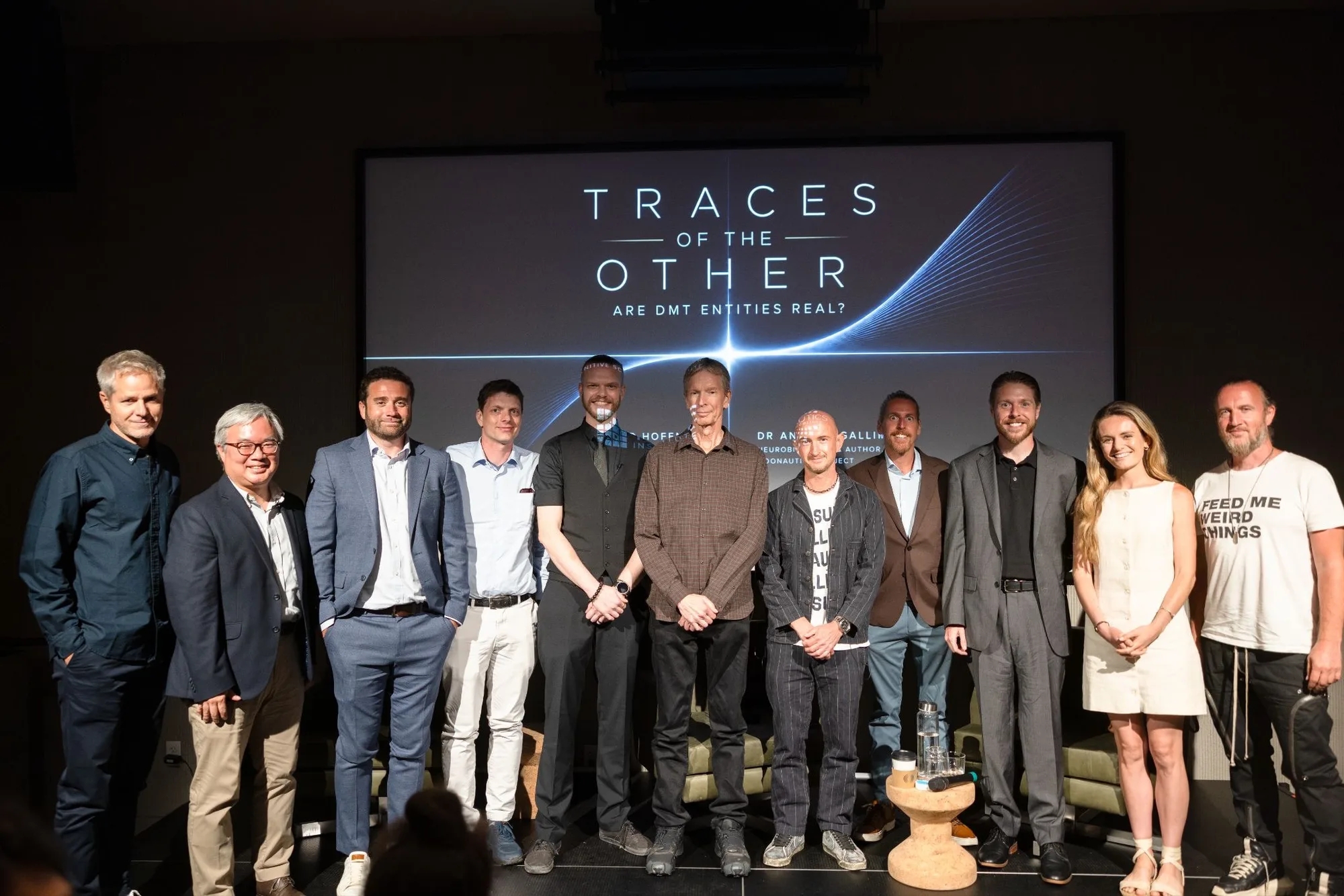
Traces of the Other
Donald Hoffman and Andrew Gallimore in conversation at The Lighthouse Campus in Los Angeles, moderated by Charles Yokoyama. Could DMT temporarily transform the human perceptual interface, making conscious agents that are normally invisible to us perceivable?
Watch the full conversationThe major conversations
Hoffman's long-form conversations on the most significant science-and-ideas podcasts and lecture stages. Click any thumbnail to watch the full episode on YouTube.
Reality is an Illusion: How Evolution Hid the Truth
A long-form conversation on the Interface Theory of Perception, the formal argument against veridical realism, and the case for consciousness as fundamental.
Do we see reality as it is?
The Institute's founding argument, distilled into eighteen minutes for a general audience. Over six million views.

The Nature of Reality
A conversation with Impact Theory host Tom Bilyeu on the structure of reality, consciousness, and the future of human understanding.
Donald Hoffman Proves That We Live in a Simulation
An animated short distilling the conscious-agents argument into a viral introduction. Millions of views, often the first encounter people have with the work.
Reality, Consciousness, and Conscious Agents
Hoffman with Robert Lawrence Kuhn, the philosopher behind public television's longest-running series on fundamental questions in science.
Reality Does Not Exist
Cosmologist Brian Keating presses Hoffman on the physics-side of the conscious-agents framework: time, geometry, and where the standard model fits.
The full archive is being assembled.
See more on YouTubeOriginal explainers and dispatches from the team
Forthcoming original films and explainers produced by the Institute, alongside short updates and reflections on the work in progress. For now, follow the Institute's work on social media for any updates.
Press
The Trace Institute Logo
The Trace Institute Logo is a working demonstration of the mathematical theory. The mark references square matrices, the fundamental objects of linear algebra, quantum theory, and Markov networks. It contains a fractal self-similarity that mirrors the structure of the Recursive Trace Logic.
The logo also embeds a real perceptual illusion. The geometry produces a visual effect that your visual system resolves in a specific way, even though the marks on the page are neutral to that interpretation. This is an example of the Interface Theory of Perception: what you perceive is not what is there but instead what your perceptual system constructs.
The logo is the thesis, while the illusion is the argument.